How to Consolidate Credit Cards Into One Payment
Learn how to consolidate credit cards into one payment. Compare balance transfers, personal loans, HELOCs, and credit counseling. Save up to $20,000.
Written by

Sarah Chen
Senior Financial Editor - CPA, CFA
Sarah Chen is a Certified Public Accountant and Chartered Financial Analyst with 12+ years of experience in personal finance and tax planning. She previously worked as a senior analyst at a major US investment firm and now leads Qudexa's finance and tax content. Sarah reviews every calculator formula and finance guide on Qudexa for accuracy.
Reviewed by David Park (CFA, MBA)
Last reviewed: October 15, 2026
🤍 Found this helpful?
Give it a like — it helps others discover it
How to Consolidate Credit Cards Into One Payment
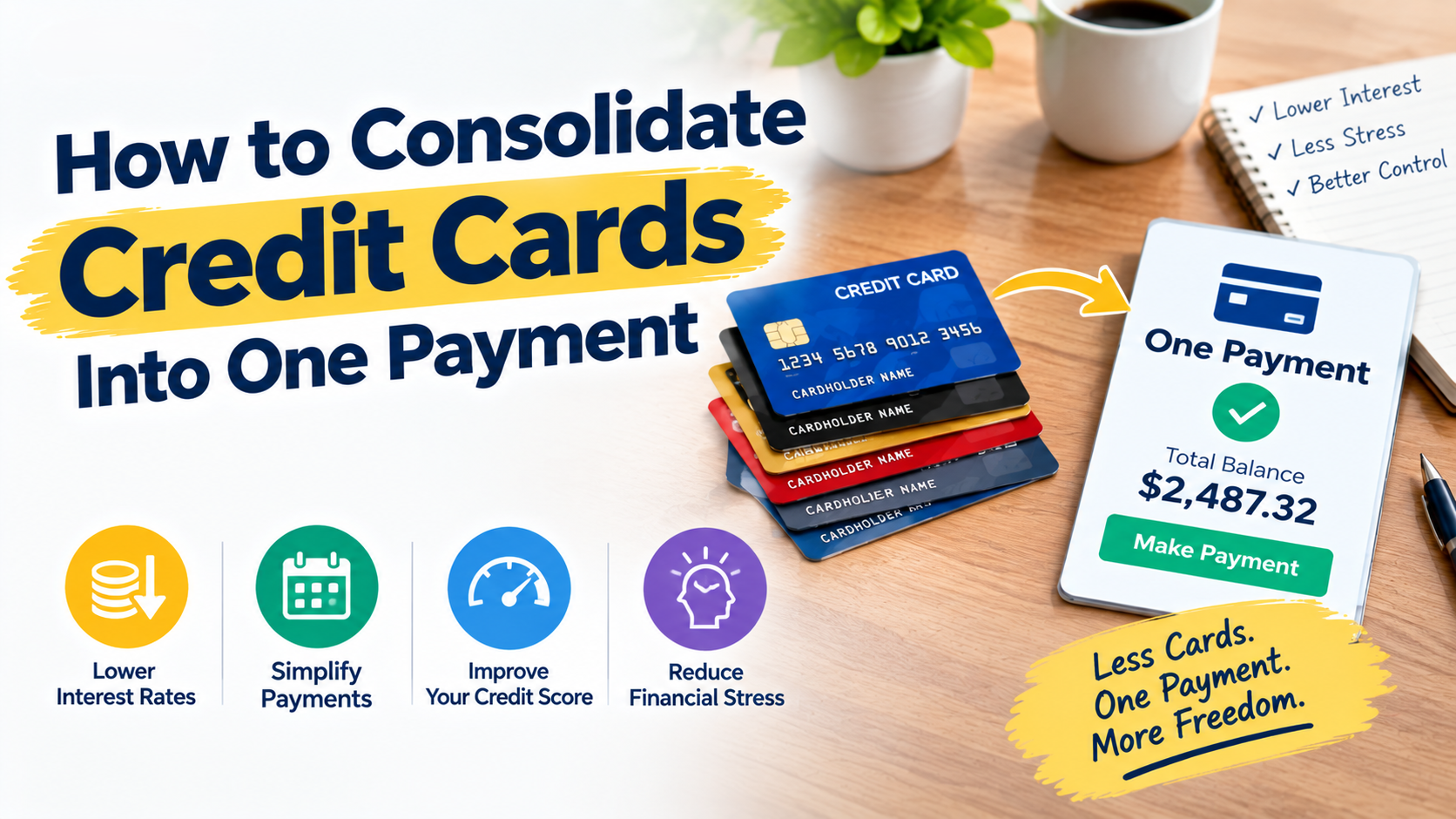
Managing five credit cards with five due dates, five minimum payments, and five different APRs is exhausting. Consolidating multiple credit cards into a single payment simplifies your finances and often lowers your effective interest rate. This guide covers every method and helps you pick the right one.
What Is Credit Card Consolidation?
Credit card consolidation combines multiple credit card balances into one loan or one card. Instead of juggling 4-6 payments, you make a single monthly payment - usually at a lower interest rate than the average card APR.
4 Methods to Consolidate Credit Cards
1. Balance Transfer to a 0% APR Card
Open a new card with a 0% introductory APR period (typically 12-21 months) and transfer balances from your existing cards.
- Pros: Zero interest during promo period, single payment, fast payoff
- Cons: 3-5% transfer fee, must pay off before promo ends or rate spikes
- Best for: Balances you can pay off in 12-18 months
2. Personal Loan (Debt Consolidation Loan)
Take out an unsecured personal loan and use it to pay off all credit card balances. Typical rates: 7-15% APR.
- Pros: Fixed rate, fixed term (usually 2-7 years), predictable payoff date
- Cons: Requires decent credit, origination fee 1-5%
- Best for: Larger balances ($10,000+) you need 2-5 years to pay off
3. Home Equity Loan or HELOC
If you own a home with equity, use it as collateral for a low-interest loan (typically 6-10% APR).
- Pros: Lowest rates, tax-deductible in some cases
- Cons: Puts your home at risk if you default
- Best for: Homeowners with substantial equity and a firm payoff plan
4. Nonprofit Credit Counseling (DMP)
A Debt Management Plan through a nonprofit (NFCC member) negotiates lower rates with your creditors and consolidates payments into one.
- Pros: No loan required, reduced rates (often 6-10%)
- Cons: Monthly fee ($20-$50), can hurt credit temporarily
- Best for: Struggling borrowers with poor credit
Comparison Table
| Method | Typical Rate | Best For | Watch Out For |
|---|---|---|---|
| Balance transfer | 0% promo, then 18-25% | Paying off in 12-18 months | Transfer fee, post-promo rate |
| Personal loan | 7-15% | Balances $10k+, 2-5 year payoff | Origination fee, credit hit |
| HELOC / Home equity | 6-10% | Homeowners with equity | Risking your home |
| DMP (counseling) | 6-10% | Bad credit, need help | Monthly fee, credit impact |
Worked Example: $15,000 Across 4 Cards
Current situation: 4 cards, average 22% APR, $450/month total minimum payments. Time to pay off: 22+ years. Interest paid: $25,000+.
After consolidation (personal loan at 11%, 5 years):
- Monthly payment: $326 (lower than $450 minimums)
- Total interest: $4,570
- Debt-free in exactly 5 years
- Savings: $20,000+
Which Method Should You Pick?
- Good credit (700+), small balance: Balance transfer to 0% APR card
- Good credit, larger balance: Personal loan at 7-12%
- Homeowner with equity: HELOC or home equity loan
- Poor credit: Nonprofit credit counseling (NFCC)
Common Mistakes to Avoid
- Running up the old cards again. This is the #1 killer of consolidation efforts. Cut them up or freeze them.
- Missing a payment. One missed payment can spike your rate to 29%+.
- Not accounting for fees. A 5% transfer fee on $10,000 = $500 upfront.
- Using a HELOC without a payoff plan. You are risking your home - treat it as seriously as a mortgage.
- Choosing the wrong lender. Compare 3-5 offers before signing.
How to Do It - Step by Step
- Add up all credit card balances and average APR.
- Check your credit score (get free reports at annualcreditreport.com).
- Decide on method - balance transfer, personal loan, HELOC, or DMP.
- Get 3-5 quotes from lenders or credit counselors.
- Choose the lowest total cost, not just the lowest rate.
- Use the new funds to pay off all existing cards in full.
- Close or freeze the paid-off cards - keep the oldest one open for credit history.
- Set up autopay on the new loan.
- Track progress monthly. Celebrate milestones.
Frequently Asked Questions
Does consolidating credit cards hurt my credit?
Initially, a small dip from the hard inquiry and new account. Long-term, consolidation improves credit as your utilization drops and payments become consistent.
What is the best way to consolidate credit cards?
For most people: a 0% APR balance transfer if you can pay off within 12-18 months, or a personal loan if you need 2-5 years.
Is debt consolidation a good idea?
Yes if you commit to not running up the cards again and stick to the payoff plan. It is a bad idea if you treat it as permission to spend more.
Can I consolidate credit cards with bad credit?
Balance transfers and personal loans require decent credit. With bad credit, try nonprofit credit counseling (NFCC) or a secured personal loan.
How long does consolidation take?
Balance transfers: 3-10 days. Personal loans: 1-7 days after approval. HELOC: 2-6 weeks. DMP: 1-2 weeks to enroll.
Should I close the old cards after consolidating?
Keep the oldest one open (for credit history length) but pay it off and stop using it. Closing all cards can hurt your score.
What is the difference between consolidation and debt settlement?
Consolidation combines debts and pays them in full. Settlement negotiates to pay LESS than owed (damages credit, tax consequences). They are very different.
Related Tools on Qudexa
Tags
🤍 Found this helpful?
Give it a like — it helps others discover it
Explore Free Calculators
Use our free online tools to calculate real numbers instantly.