
💳 Credit Card Debt: The American Reality
The average American household carries $6,500+ in credit card debt. With APRs averaging 22–24%, minimum payments keep millions trapped for decades. But you can escape — and faster than you think.
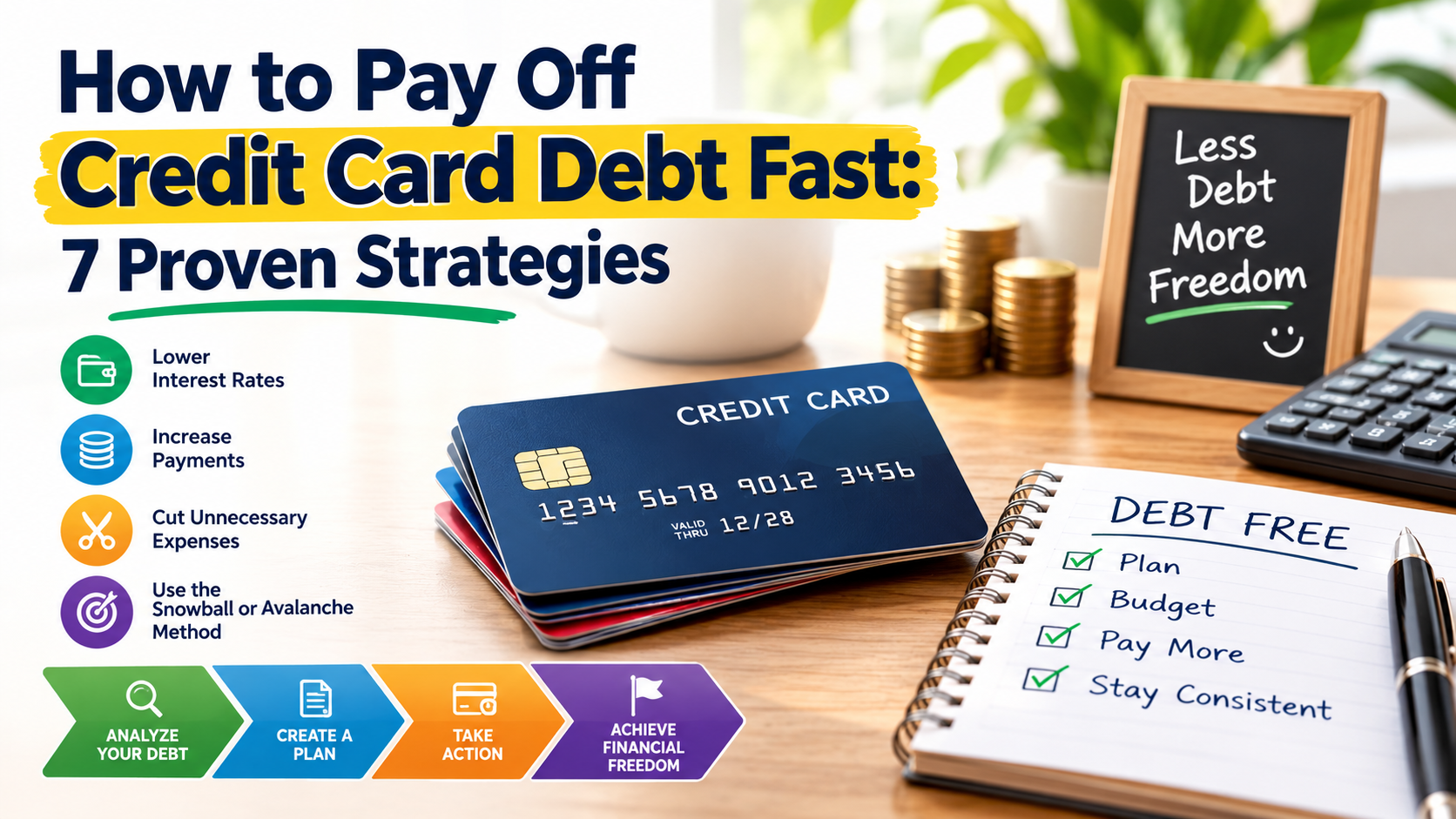
This guide ranks 7 proven strategies from fastest to slowest. We'll cover the math behind each, who they work best for, and how to combine them for maximum impact.
A $6,500 balance at 22% APR with minimum payments (2% or $25) takes 22+ years to pay off and costs $10,000+ in interest. That's the trap. Here's how to escape it.
🏆 Strategy #1: Debt Avalanche (Fastest Overall)
Pay minimums on everything, then throw every extra dollar at the highest APR card. Once paid off, roll that payment to the next highest APR.
✅ Best for: People motivated by math · Saves the most money
⚡ Strategy #2: Debt Snowball (Fastest Wins)
Pay minimums on everything, then throw every extra dollar at the smallest balance. Eliminating accounts fast builds momentum.
✅ Best for: People who need emotional wins · Read our full Debt Snowball Guide
💸 Strategy #3: Balance Transfer
Move high-APR balances to a 0% APR balance transfer card (typically 15–21 months). Pay aggressively during the promo period and you slash interest dramatically.
| Without Transfer | $6,500 at 22% APR | ~$500/yr interest |
| With 0% Transfer | 3% transfer fee = $195 | $0 interest for 18 months |
⚠️ Warning: Only works if you pay off before the promo ends. Otherwise you're stuck with a higher rate.
🏦 Strategy #4: Debt Consolidation Loan
Combine multiple cards into a single fixed-rate personal loan at 10–15% APR. You save on interest, simplify payments, and get a fixed payoff date.
💼 Strategy #5: Negotiate with Creditors
If you're behind on payments, call your creditors. Ask about:
- Hardship programs — temporarily reduce rate or pause payments
- Debt settlement — pay 40–60% of balance (damages credit)
- Rate reduction — direct ask, works surprisingly often
📈 Strategy #6: Increase Income, Not Just Cut Costs
Cutting expenses has a ceiling. Earning more has none. Even $200 extra/month from gig work, freelance, or a raise cuts years off your payoff time:
On $6,500 at 22% APR:
- Paying minimum only → 22+ years
- Paying $200/month → 3.2 years
- Paying $400/month → 1.5 years
- Paying $600/month → 1 year
💪 Strategy #7: Automate Everything
Willpower is finite. Automation isn't:
- Set autopay for at least the minimum on all cards
- Schedule extra payments for the day after payday
- Use a separate checking account just for debt payments
- Track progress monthly with the Credit Card Payoff Calculator
🎯 Which Strategy Is Right for You?
Math-minded? → Avalanche
Need motivation? → Snowball
Good credit + discipline? → Balance transfer
Multiple cards + want simplicity? → Consolidation loan
Falling behind? → Negotiate with creditors
Want to speed up everything? → Increase income + automate
If you're overwhelmed, contact a non-profit credit counselor at NFCC.org — free or low-cost, unlike "debt relief" companies that charge 20%+ fees.
❓ FAQ
Is it better to pay off smallest or highest interest first?
Mathematically, highest interest first (avalanche). Psychologically, smallest first (snowball). Studies show people who use snowball are more likely to finish — because momentum matters.
Should I use my emergency fund to pay off debt?
Keep 1 month of expenses. Anything above that, throw at high-APR debt. Draining your entire safety net is risky — one emergency and you're back in debt.
Will closing cards hurt my credit score?
Yes — closing cards lowers your available credit and increases utilization. Pay them off but leave them open (or use them for small recurring bills) to protect your score.
How long until I'm debt-free?
Depends entirely on your payment amount. Use the Credit Card Payoff Calculator — enter your balance, APR, and monthly payment to see your exact payoff date.
See Your Debt-Free Date
Free calculator shows payoff time, total interest, and how much you save with extra payments.
🧮 Try the Credit Card Payoff Calculator →