
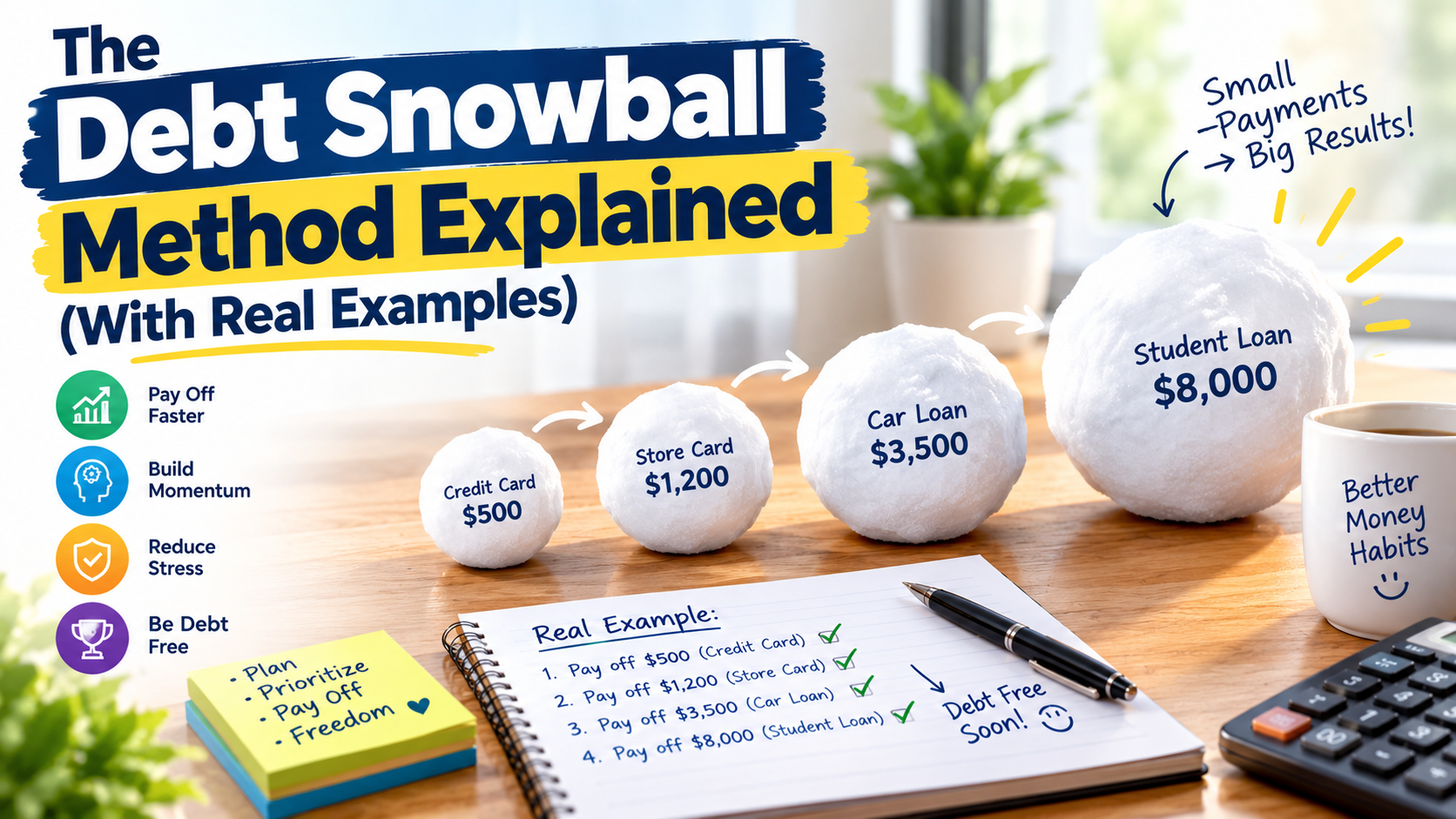
❄️ The Debt Snowball Method
You've heard the advice: "Pay off the highest interest rate first — it saves the most money." That's called the avalanche method. And mathematically, it's correct. But it doesn't work for most people.
The debt snowball method takes the opposite approach: pay off the smallest balance first, regardless of interest rate. Yes, you pay slightly more interest overall. But you finish more often — and finishing is what matters.
1) List all debts from smallest to largest balance. 2) Pay minimums on everything. 3) Throw every extra dollar at the smallest debt. 4) When it's gone, roll that payment into the next one. Repeat.
📊 Real Example: Sarah's Snowball
Sarah has $14,000 in debt across 4 accounts and $600/month to put toward debt (minimums + $250 extra):
| Debt | Balance | APR | Min Pay |
|---|---|---|---|
| Store Card (smallest) | $800 | 24% | $35 |
| Credit Card A | $2,500 | 22% | $65 |
| Credit Card B | $4,200 | 19% | $95 |
| Student Loan | $6,500 | 6% | $155 |
The Snowball Order & Timeline
Total paid: ~$16,800 (including $2,800 interest)
Total time: 30 months
⚖️ Snowball vs Avalanche
| Feature | ❄️ Snowball | 🏔️ Avalanche |
|---|---|---|
| Payoff order | Smallest balance first | Highest APR first |
| Total interest | Higher | Lower |
| Motivation | Very high | Medium |
| Completion rate | Higher (per studies) | Lower |
| Best for | Most people | Math-driven |
Research from Northwestern's Kellogg School found that people who paid off smaller debts first were more likely to stay on track long-term than those using avalanche. Behavior beats math.
🎯 How to Start Your Snowball
- List all debts — balance, minimum, APR
- Order by balance — smallest to largest
- Pay minimums on everything except the smallest
- Attack the smallest with every spare dollar
- Celebrate the win — that's part of the system
- Roll the payment into the next debt (this is the "snowball")
- Repeat until debt-free
Plan yours with the Debt Snowball Calculator — it handles unlimited debts and shows your exact payoff order and timeline.
❓ FAQ
Who invented the debt snowball method?
Dave Ramsey popularized it in his book The Total Money Makeover. But the concept predates him — behavioral economists have documented the "small wins" effect for decades.
Does the snowball method hurt my credit score?
No — paying off debt improves your score. Just don't close the accounts (that hurts your credit utilization ratio). Pay them off and leave them open.
Should I include my mortgage in the snowball?
Usually no — mortgages are secured, lower-rate, and long-term. The snowball method is best for consumer debt (credit cards, personal loans, medical, student loans).
What if my smallest debt is also my highest interest?
Then it's a no-brainer — attack it. When snowball and avalanche agree, you get the fastest payoff AND the lowest interest.
Plan Your Debt Snowball
Free calculator shows your exact payoff order, timeline, and total interest saved.
🧮 Try the Debt Snowball Calculator →